


Data center construction spending is driving nonresidential growth in 2026: spending on data center construction rose more than 73% year over year, and without data centers and related power work, much of the national nonresidential picture turns negative. South Texas is in the middle of that shift. Nearly 50 data centers are planned or completed in San Antonio alone, creating a concentrated pipeline with unusual demands on labor, materials, field leadership, and project controls.
For South Texas commercial and industrial contractors, specialty subcontractors, project managers, executives, and workforce leaders, this is not just a market headline. It changes how you plan capacity, qualify pursuits, protect margins, and decide where to invest crew development and management attention. Artificial intelligence and cloud computing demand is driving data center construction, and that demand is pulling labor, materials, and management capacity away from other private segments.
This article is not a market recap. It is a decision brief on the 2026 spending surge, the South Texas impacts, the risks and readiness factors that separate good fits from bad ones, and the practical go/no-go criteria contractors can use to decide whether to chase more data center work or qualify it harder. The opportunity is real, concentrated, and operationally demanding.
2026 Spending Signal: Data Centers Lifting Nonresidential Construction
The numbers through the second half of 2026 tell a clear story. Based on federal monthly construction releases from the Census Bureau, national nonresidential construction spending has posted six consecutive monthly increases, with the seasonally adjusted annual rate crossing $1.3 trillion. Data center construction spending accelerated at a 14.9% annualized pace, and in August, data center spending alone jumped 7.5% month over month and more than 73% year over year. Within Private construction, nonresidential spending outside data centers and power infrastructure was down roughly 5.9% compared to the prior year.
Those monthly figures come from a federal dataset.
Global data center construction spending is projected to reach $1.4 trillion in 2027. North America holds the largest market share for data center construction, and the global data center construction market is projected to grow at an annual rate of 9% to 10%. Sustained data center growth is expected to continue through the 2030s.
Three numbers every South Texas executive should know:
- Data center spending rose more than 73% year over year in August 2026
- Private nonresidential spending excluding data centers fell roughly 5.9% over the same period
- Manufacturing construction dropped nearly 20% year over year and sits roughly 32% below its September 2024 peak
Why the Boom Is Concentrated: Data Centers, AI, and Power, Not a Broad Recovery
This is not a broad recovery. Data centers and related power infrastructure are doing most of the work to keep national nonresidential construction spending positive. AI infrastructure is increasingly treated as a primary investment asset class, and investment is shifting toward large-scale developments rather than smaller, standalone data center facilities.
AI workloads require advanced GPU-dense server configurations and specialized facility adjustments that bear little resemblance to traditional commercial construction. Data center electricity consumption is expected to increase significantly, driven by AI. Air-cooling systems are insufficient for the heat generated by high-density AI racks, so cooling-technology innovations are critical for high-density AI workloads in data centers. Future data center infrastructure will prioritize electrical systems and cooling technologies, and grid capacity is crucial for these high-power projects.
Traditional office construction (excluding data centers) is declining. Manufacturing is weak. Retail and discretionary commercial work remain soft, pressured by rising costs and tighter credit.
Why concentration matters for your firm:
- Labor cost escalation is sharpest in electrical, mechanical, and commissioning trades that serve data center work
- Procurement competition for switchgear, generators, and chillers is intense; lead times stretch past standard schedules
- A narrow set of owners and developers controls most of the demand, concentrating pricing power
- Firms without mission-critical track records face higher barriers to entry and tighter margins
- Rapid growth in one segment can represent a narrow opportunity rather than health in adjacent market sectors
- The economy rewards specialization here, not general ability to execute this work profitably
South Texas Lens: How National Data Center Trends Show Up in San Antonio and the Region
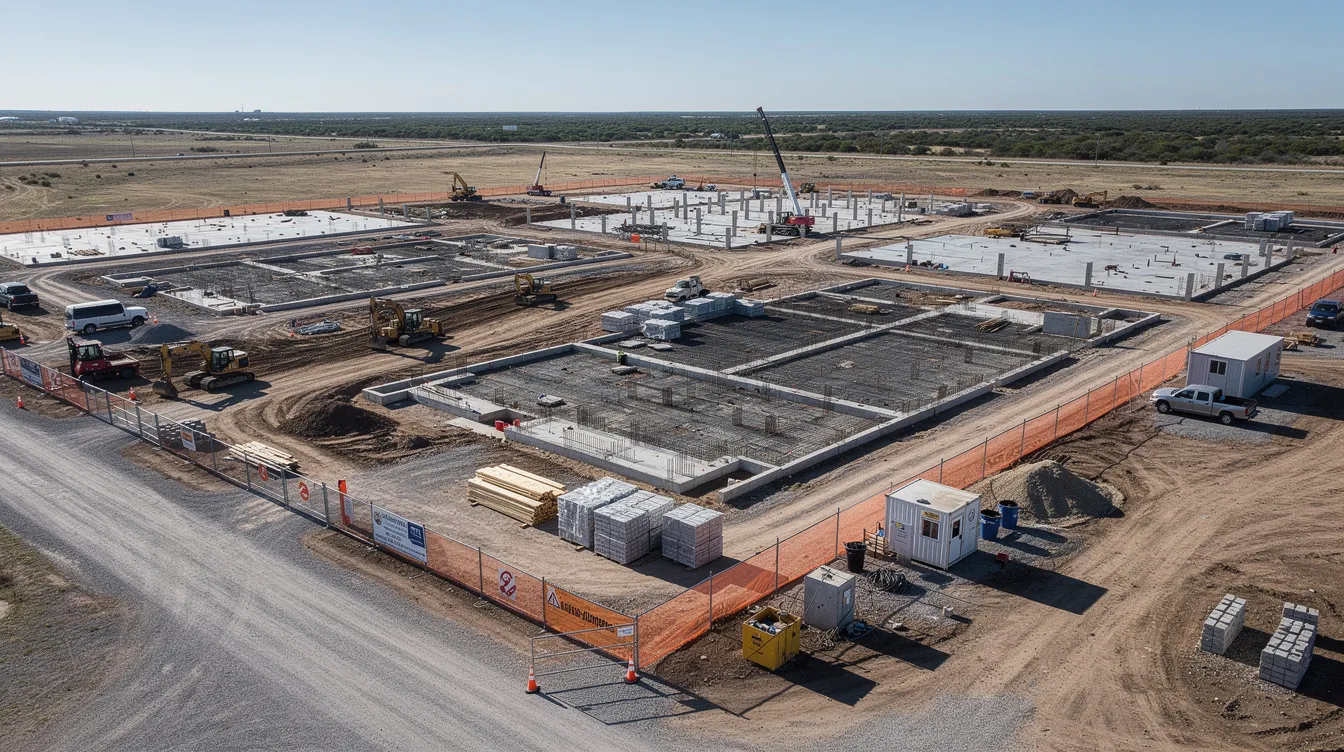
Nearly 50 data centers are either completed or planned in San Antonio, making the city one of the most active data center markets in Texas, though some proposed facilities have not yet broken ground. The I-35 corridor and the broader South Texas region are seeing emerging projects in areas historically associated with manufacturing, warehousing, and logistics, and the corridor also supports cross-border trade with Mexico.
- Power: Power availability is a primary constraint in data center development. Data centers in Texas may require five times more power than existing facilities. Statewide, data centers may require up to 100,000 megawatts of power, and data centers account for 70% of the largest energy requests in Texas. Power grid connection delays are a major issue affecting data center construction timelines, with ERCOT queue timing directly affecting construction sequencing for campuses in the San Antonio and I-35 corridor, and adequate grid capacity is crucial to where developers choose to build.
- Water: Data centers could account for 3% to 9% of Texas’ water use by 2040. Texas data centers could consume 29 to 161 billion gallons of water by 2030. Globally, data centers could consume 25 billion gallons of water by 2025. A proposed data center in San Marcos would consume over 25 million gallons of water annually, a figure that drew significant scrutiny from residents.
- Public opinion: Local residents may press for more transparency on water, energy, noise, and land-use impacts, and public opinion influences site selection for data center construction. Some San Antonio area projects have stalled or been canceled after zoning disputes.
- Market dynamics: Vacancy rates in primary global data center hubs are extremely low, such as 0.3% in Northern Virginia, which is pushing demand into emerging markets. Demand is shifting to emerging markets because traditional markets are reaching capacity. South Texas fits that pattern, and contractors can use a map of corridor opportunities to evaluate where growth is clustering. Data centers are increasingly integrated with renewable energy sources to address environmental regulations, adding complexity to site planning and infrastructure development.
- Land and entitlements: Land banks in key San Antonio submarkets are limited. Contractors face longer entitlement horizons for data center projects, and permitting timelines remain uncertain in several jurisdictions.
Who Should Lean In: Profiles of Contractors Built for Data Center Work
Data center projects require specialized workforce training and planning, and long-term workforce development often depends on local partnerships. Firms that already have the bench, the systems, and the relationships should be leaning into this market aggressively.
Nationally, contractors added approximately 95,000 positions since August 2024, but the growth is not evenly distributed, with some companies scaling training and hiring specifically for mission-critical work. Accelerated data center pathway programs report 90% job placement, and the I-35 corridor’s workforce is projected to grow by 21.2%. Industry reporting indicates South Texas offers apprenticeship programs in multiple trades, and these partnerships help firms build a stronger pipeline over time for mission-critical work.
Capabilities that signal readiness:
- Prior completion of critical-power systems: UPS rooms, generator yards, medium-voltage switchgear
- Experienced chilled-water or DX cooling plant installation teams
- Commissioning and QA/QC processes that meet hyperscale or colocation owner standards
- Deep superintendent and foreman benches capable of running concurrent shifts on compressed schedules
- Mature safety programs, including energized-work protocols and heat-illness prevention
- Established relationships with owners, developers, or general contractors active in the South Texas data center market
- Experience managing high-density server room buildouts or similar mission-critical facility scopes
- Active investment in apprenticeship and craft development for electrical, pipefitting, and sheet metal trades
Who Should Qualify Harder or Walk Away: When Data Center Work Is a Stretch
Not every strong market signal is a good-fit project. Nationally, 55% of contractors reported project cancellations due to rising costs over the previous six months, underscoring the risk of pursuing work without the right capacity.
Warning signs that you should pass, partner as a tier-two supplier, or limit your scope:
- Your electrical bench is shallow and would require hiring an untested crew for the project window
- You have no prior commissioning experience on mission-critical facilities
- Your firm depends on a single, already overbooked specialty trade partner for mechanical or controls work
- Supervisor capacity is already stretched across multiple corridor industrial or federal projects, and the planned pace would outrun safe oversight and decision-making speed
- You are unfamiliar with liquidated damages structures common in data center contracts
- Your cash-flow model cannot absorb the retainage and payment timing typical of large campus developments
- You are underestimating the compressed schedule, turnover documentation, and energized-work risk that data center construction demands
Smaller subcontractors should consider niche roles (concrete, civil and site work, or select low-voltage scopes) rather than trying to prime an entire data center campus. Merit shop contractors in South Texas benefit from open competition, but disciplined go/no-go decisions protect your firm from low-margin volume chasing.
A Practical Go/No-Go Checklist for Data Center Construction Pursuits
Before committing estimating, preconstruction, or field leadership resources on any new data center RFP, map the opportunity against available supervisory and trade capacity before bidding:
- Supervisory capacity: Do you have qualified foremen and superintendents available in the target construction window, and the ability to absorb delays without disrupting other active work, or would you be pulling leaders off other active projects?
- Trade availability: Can you reliably staff electrical, mechanical, and controls trades without dependence on a single vendor or subcontractor?
- Power-interconnection timeline: Have you verified ERCOT, CPS Energy, or other local utility milestones for power delivery that align with construction sequencing?
- Schedule realism: Does the schedule account for long-lead equipment (switchgear, chillers, generators) and the integrated testing and commissioning required before turnover?
- Liquidated damages: Are the LD clauses proportionate to the contract value, or do they expose your firm to outsized risk on a compressed schedule?
- Cash-flow implications: Can you absorb the retainage, mobilization costs, and payment timing without straining other projects?
- Owner and GC payment history: Have you verified the payment track record of the owner and general-contractor companies on prior data center or mission-critical work?
- Safety and energized-work planning: Do you have documented protocols for energized-work exposure, heat-illness prevention, and congested-site logistics?
- Modular and prefab strategy: Developers are using modular and prefabricated designs to accelerate construction timelines; can your team integrate prefabricated assemblies into your sequencing plan?
- Margin target: Have you documented a clear margin target and walk-away number before pricing?
Protecting Margin on South Texas Data Center Projects That Are a Fit
Early involvement in preconstruction is the single most effective margin-protection move. Shaping scope, sequencing, and procurement before construction starts prevents the late changes that erode profit on mission-critical work. Data centers require five times more power than existing facilities, meaning the electrical and mechanical scope alone can determine whether a project is profitable.
For South Texas conditions, plan night shifts around heat exposure and system cutovers. Sequence work to minimize rework on highly congested campus sites. Coordinate closely with insurers and sureties as the data center backlog expands rapidly.
Margin-protection practices for South Texas data center work:
- Negotiate escalation clauses for key materials (copper, steel, switchgear) with clear trigger mechanisms
- Lock in long-lead procurement early; secure vendor relationships for generators, chillers, and specialty controls equipment with realistic lead-time commitments
- Staff projects with experienced foremen who have managed energized environments and multi-trade coordination
- Plan labor around South Texas heat: schedule high-exposure work during cooler hours and build rest cycles into productivity estimates
- Use apprenticeship and craft training to build a reliable bench of electricians, pipefitters, and sheet metal workers for mission-critical work rather than relying solely on spot-market labor
- Price commissioning, integrated systems testing, and turnover documentation as standalone line items, not buried overhead
- Establish clear owner-furnished equipment delivery milestones in your contract, with schedule-relief provisions for delays
- Review bonding capacity and insurance terms before committing to multiple simultaneous data center projects
Second Half of 2026 and Beyond: What to Watch in Data Center and Nonresidential Construction
The spending data confirms that the market remains concentrated. If data center and power spending continue to climb while other private nonresidential categories stay flat or decline, the opportunity will remain intense but narrow.
Quarterly watch items for South Texas leadership teams:
- Monthly nonresidential construction spending releases: track whether data center share of the total continues to grow, and link any apparent trend shift back to the underlying source when validating it against comparison references such as Our World in Data
- ERCOT interconnection approvals and CPS Energy capacity updates for planned San Antonio area campuses
- Zoning, permitting, or moratorium actions by San Antonio, Bexar County, or surrounding jurisdictions related to water and energy use, as city officials may also ask operators and companies for more transparent resource-use information to inform residents
- Interest rate changes and Treasury yields that affect financing costs and project feasibility
- Inflation and labor cost escalation in electrical, mechanical, and commissioning trades
- New campus announcements or cancellations along the I-35 and I-10 corridors
- Your own backlog quality metrics: hit rates on mission-critical bids, labor turnover in key trades, and ratio of paper backlog to executable backlog
- Federal infrastructure and energy policy developments that could affect data center development in Texas
One Concrete Next Step: 30-Day Review of Data Center Pursuits and Backlog
Assemble your leadership, estimating, and field operations teams within the next 30 days to review every current and pending data center and power-related opportunity in your pipeline.
- Re-score each pursuit using the go/no-go checklist above; categorize every opportunity as “must pursue,” “qualified partner only,” or “decline”
- Separate paper backlog from executable backlog for all data center and mission-critical jobs; if a project depends on utility milestones or entitlements that are unresolved, flag it as conditional
- Identify specific training or apprenticeship investments needed in the next enrollment cycle to support data center work, including electrical, pipefitting, and sheet metal trades
- Contact industry reporting South Texas for current apprenticeship, safety, and leadership development options that align with mission-critical construction demands
The 2026 data center spending surge is real, and South Texas is positioned to capture a meaningful share of the work. But the firms that will profit from this period are not the ones chasing every RFP. They qualify harder, protect margin, and build the workforce to execute. Disciplined selection and workforce investment will determine whether this surge strengthens your business or strains it. The spending data is clear. Your response to it is the variable.


