


Introduction: Why Preconstruction Steel Logistics Decides Whether Erection Starts on Time
Preconstruction steel logistics covers every coordination, site readiness, and sequencing decision the GC and steel team must finalize before the first flatbed rolls through the gate. That includes site preparation, delivery coordination, site layout, laydown planning, crane positioning, and erection order. Steel erection begins with foundation preparation and anchor bolt verification, and preconstruction logistics involves planning and coordinating heavy materials transport to ensure foundations, access points, and staging areas are ready to receive what arrives.
The stakes are not abstract. One missed access condition or unfinished footing can idle a crane at thousands of dollars per day and stack trades on tight I-35 corridor and San Antonio infill job sites with no room to absorb delay. On constrained urban or campus projects, the downstream cost of a single day of erection delay can ripple through concrete placement, fire suppression, roofing, and envelope trades for weeks.
Steel erection ranks among the most hazardous construction operations according to Bureau of Labor Statistics fatality data, year after year. Poor logistics raise both schedule risk and serious-injury risk, especially falls, struck-by incidents, and suspended loads over workers. This article delivers a practical, OSHA-aligned pre-arrival checklist for structural steel, not generic material handling advice.
Before your next steel delivery, confirm these gating items during the week before arrival:
- Written foundation strength notification in the steel erector’s hands
- Access roads tested, approved, and clear for 70-ft trailers
- Laydown zones marked, segregated by member type, and within crane reach
- Crane pad firm, level, and drained with soil bearing verified
- Delivery schedule matched piece by piece to the erection order
OSHA Expectations Before Steel Erection Begins
OSHA’s steel erection standard (29 CFR 1926 Subpart R, § 1926.752) places specific obligations on the controlling contractor before any steel components leave the ground. These are not suggestions. They are documented prerequisites, and a superintendent who cannot confirm them in writing before erection day is exposing the project to enforcement action, schedule failure, and injury.
Here is what the controlling contractor must verify:
- Foundation strength notification. The erector must receive written confirmation that footings, piers, and walls have reached at least 75% of design compressive strength (tested per ASTM field-cured samples) or are otherwise sufficient to support erection loads. Complete and document any anchor rod repairs or modifications before erection begins. This is a code compliance and inspection gate, not a verbal handshake.
- Site layout and access. The controlling contractor must provide and maintain access roads into and through the site adequate for safe delivery of materials and movement of cranes and trucks. A firm, properly graded, drained area must be available for material storage and equipment operation.
- Hoisting pre-planning. Pre-plan all overhead hoisting operations so employees do not work directly below suspended loads, except under limited, controlled conditions. Crane paths, outrigger locations, and exclusion zones must be determined before erection begins.
- Site-specific erection plan. If site conditions require alternate methods, a qualified person must prepare a site-specific erection plan covering erection sequence, temporary bracing, fall protection, rescue procedures, and competent person assignments.
- Permits and safety plans. All necessary permits must be confirmed before erection begins. Implement fall protection systems during steel erection. Emergency response plans must be communicated to all workers. Clear communication about hazards is crucial for worker safety.
Site Preparation and Layout: Is the Ground Really Ready for Steel?
Site preparation typically begins weeks before steel erection starts, yet it is one of the most frequently underestimated phases of preconstruction steel logistics. If the ground is not ready, nothing else matters.
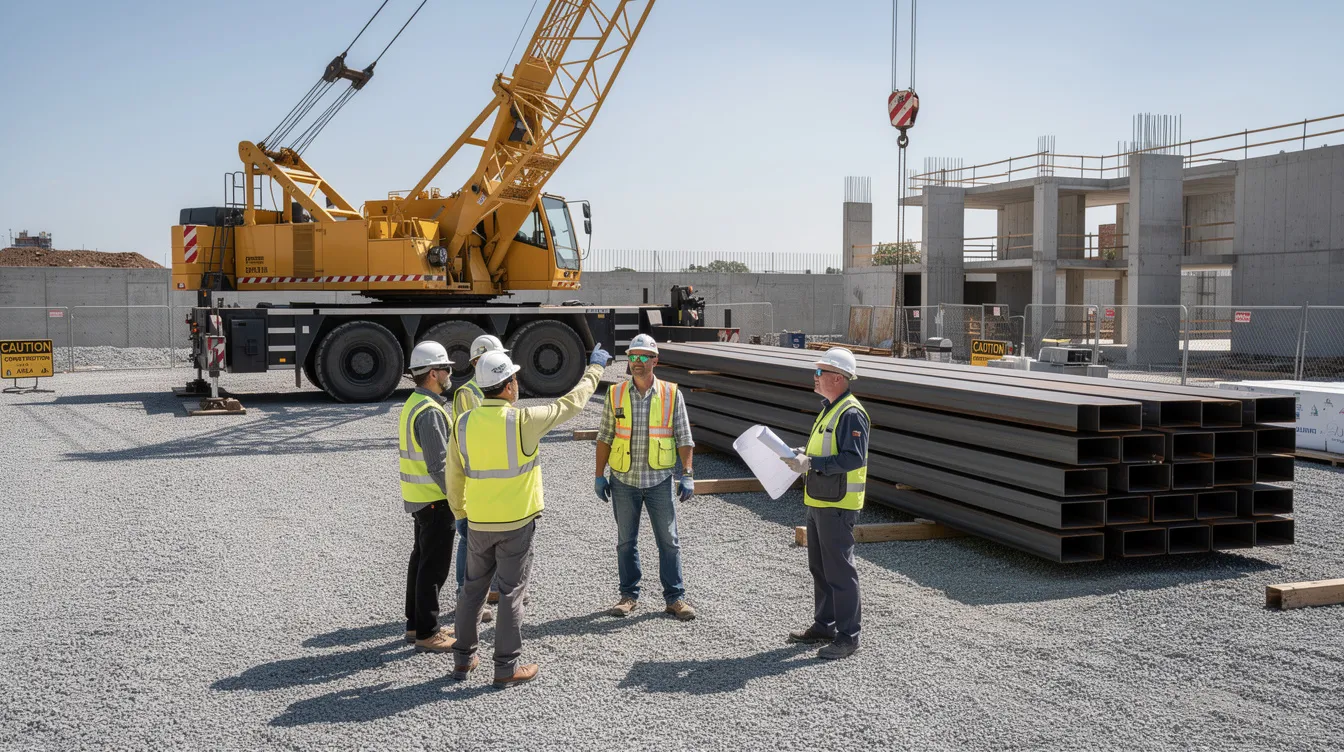
Before the first trailer arrives, a GC must confirm finished access roads built to handle heavy loads, a firm, drained crane pad designed to soil-bearing capacity, graded laydown areas segregated by member type, and utility marking for overhead power lines and underground services. Ground conditions must support the weight of machinery and steel. Cranes require stable, level ground to operate safely during steel erection. Mark utility locates before crane operations begin.
Poor site layout creates immediate problems. Trucks back onto county roads along I-10 because the site lacks internal circulation. Cranes boxed in because secondary members and metal decking are stored inside the swing radius. Fire lanes are blocked on a healthcare expansion, compromising emergency access. Site safety is enhanced by reducing congestion and ensuring compliance with safety regulations.
South Texas soil conditions add risk. Expansive clay swells and softens with moisture. Sudden downpours between May and October can reduce bearing capacity in hours. Early stabilization with rock, mats, or temporary road base prevents last-minute crane derating or work stoppages.
Lock in these minimum site layout commitments 30 days before delivery:
- Access roads graded, compacted, and load-rated for flatbed traffic
- Crane pad elevation set, soil bearing confirmed, drainage paths established
- Laydown zones designated for primary members (columns, girders), secondary members (joists, purlins), metal decking, and connection hardware, each tied to grid lines
- Overhead and underground utilities surveyed, marked, and signed
- Erosion control and drainage in place for South Texas storm events
Aligning Construction Sequence, Erection Order, and Delivery Plan
The overall construction sequence governs how the building progresses from foundation through envelope. The steel erection order dictates which bays, columns, beams, and bracing go up in what sequence. The delivery plan determines when each steel component arrives on site. All three must align, or trades stack, cranes idle, and margins erode.
Steel construction sequencing follows engineering logic for stability. Erect braced bays first for lateral stability. Columns are typically erected starting from a braced bay for stability, then adjacent bays follow. Beams and rafters are connected to columns using bolted or welded joints, though site connections should generally be bolted for safety and speed. Temporary bracing is crucial during early erection stages for stability, and temporary bracing is essential for stability during early erection stages. Proper sequencing prevents column misalignment during erection.
Consider a six-bay data hall. The erection order starts at the core and braced bay to lock structural stability into the main frame. Columns, girders, and bracing for those zones ship together in the first release. Secondary members, joists, and metal decking follow in the next release, timed so the frame can receive them. Stairs, rails, and miscellaneous iron arrive last. Steel delivery must align with the erection sequence to keep construction efficient. Material delivery must align with erection order to avoid congestion.
Out-of-sequence deliveries force rehandling, double picks, and temporary storage in uncontrolled zones. On tight urban or campus construction sites, that means steel bundles blocking fire lanes, occupying crane paths, or sitting on uneven ground and creating safety hazards. Well-run projects achieve 100 tonnes of steel erected per week when sequence, delivery, and site readiness align. Detailed 4D BIM sequencing integrates models with schedules to streamline erection on many projects, giving the project team visibility into conflicts before they reach the field.
Access Roads, Delivery Routes, and Controlled Entry
A comprehensive site logistics plan must map out access, staging, and transportation routes before delivery coordination begins. Steel logistics are affected by factors like transportation restrictions and limited onsite storage capacity, so verify every link in the chain from fabricator yard to laydown zone.
Factor temperature and traffic delays into steel logistics planning, especially during South Texas summers, when early-morning delivery windows avoid peak heat and congestion on I-35 frontage roads. For downtown San Antonio projects, check city delivery curfews and permitted time windows.
Confirm these route-check items before scheduling deliveries:
- Load limits on bridges and overpasses between the fabricator and site
- Turning radii for 70-ft trailers at every entry, intersection, and internal turn
- Overhead clearance for tall loads (utility lines, tree canopies, building overhangs)
- Permits for oversize or overweight loads, with escorts if required
- Signage for drivers and warning signage for the public
- Off-site staging area identified if site frontage cannot handle multiple trucks at once
- Arrival spacing coordinated with the fabricator and trucking company to prevent site congestion
- Re-check triggers defined: heavy rain, utility excavation, route detours, or storm damage that changes ground conditions
Laydown, Hoisting Paths, and Crane Access
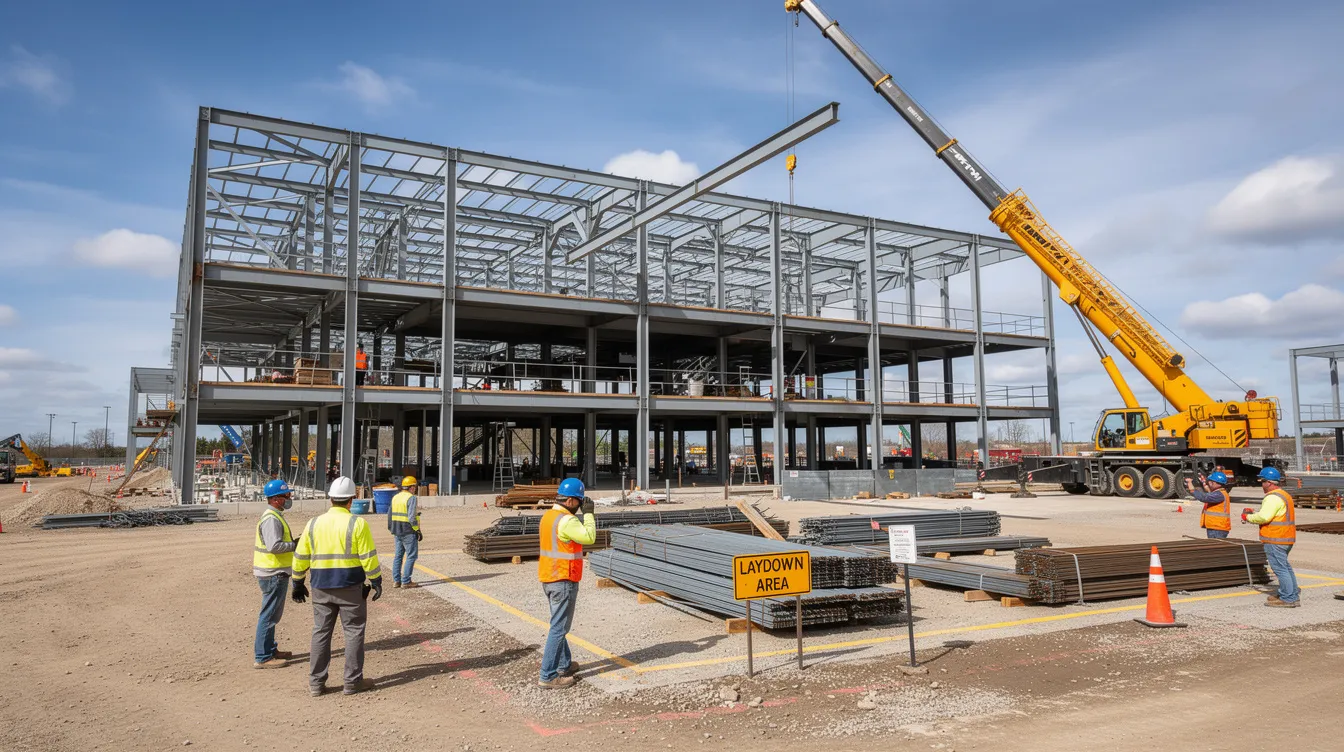
Laydown planning directly supports safe crane use and efficient steel erection. Steel must be staged in crane reach and in erection order so bundles do not need to be dragged across soft ground, over utility trenches, or through active work zones where other trades are operating.
Cranes can be mobile or non-mobile types. Mobile cranes include truck-mounted, crawler, and all-terrain cranes. Crawler cranes work well on uneven terrain when properly set up. Typical mobile cranes have a rated capacity of 30 to 50 tons, which covers most mid-rise commercial and industrial projects. Tower cranes require site assembly and are vulnerable to wind, making them a careful planning decision on exposed South Texas sites. Use hoists where cranes cannot operate because of space constraints, such as tight urban infill or interior work.
Use this hoisting-prep list before the erection date:
- Crane location selected based on boom swing, counterweight clearance, and outrigger reach; ground bearing checked with geotechnical data, mats or cribbing placed where needed
- Pick paths mapped from trailer to final position, avoiding overhead obstructions and occupied work zones
- Exclusion zones marked so no workers are under suspended loads during picks
- Laydown zones arranged so primary members (columns, girders) are closest to the crane, with secondary members and metal decking staged behind in sequence
- Loose connection hardware (anchor bolts, base plates, bolting up materials) stored separately with clear signage
- Soft or recently backfilled areas identified and avoided or stabilized before crane set-up
Every one of these items ties back to the OSHA requirement that hoisting operations be pre-planned. Mistakes here force the most costly rework in the field.
Coordinating GC, Fabricator, Erector, and Other Trades
Clear communication protocols are essential for effective steel logistics coordination. Clear roles prevent the “I thought you were handling that” failures that stall steel jobs.
- GC/Controlling Contractor: Provides site layout, access roads, permits, inspection notifications, and written foundation strength confirmation. Owns the construction sequence and coordinates other trades out of the steel erector’s path.
- Fabricator: Controls piece marking, packing sequence matched to erection order, approved drawings, shop drawing accuracy, and coating or galvanized steel finishing schedules. Early supplier and fabricator engagement helps to identify lead times and material shortages before they become field problems.
- Steel Erector: Leads the erection plan, rigging selection, crane needs, temporary works, and field supervision. Responsible for the site-specific erection plan, risk assessment, and rescue procedures.
Effective logistics planning connects various project stakeholders to minimize delays. A successful steel project requires aligning procurement, fabrication, and erection processes early. Schedule a formal steel preconstruction meeting four to six weeks before the first delivery. Agenda:
- Verify approved drawings are final and in the fabricator’s hands
- Confirm foundation cure status, anchor rod inspection, and any remediation
- Align erection sequence and delivery releases bay by bay
- Walk the site layout: crane pad, laydown, access, transport route
- Identify path conflicts with other trades (concrete, underground piping, fire sprinkler, roofing)
- Define change-control rules: what happens if a footing is not ready or weather delays site preparation
On fast-track industrial projects and data center and industrial demand work, these meetings are compressed but cannot be skipped. The decisions documented here prevent accidents and protect margins on the next phase of construction.
Common Pre-Arrival Mistakes That Derail Steel Jobs
These failure modes are realistic, common, and preventable with careful planning in preconstruction steel logistics:
- Foundations have not reached design strength or anchor bolts are mislocated, forcing costly rework before the first column can stand. Root cause: weak inspection or misaligned templates. Schedule and safety impact on many projects is measured in idle crane days.
- Missing permits or inspection sign-offs block erection release. Root cause: slow QA/QC or municipal backlog. The steel erector cannot start, and downstream trades stack.
- Crane pad or ground is not firm due to soft fill, recent backfill, or poor drainage. Root cause: no geotechnical check or inadequate site stabilization. Impact: crane derated or repositioned at significant time and cost, with tip risk in extreme cases.
- Utilities are unmarked or overhead obstructions are unaddressed. Root cause: delayed locates or survey gaps. Impact: work stoppage, damage, and safety protocols violated.
- Access roads are blocked, or laydown areas are congested with other trades’ materials. Root cause: no site layout plan or enforcement. Impact: trucks cannot reach the unload point, missing pieces cannot be found, and misplaced bundles require special handling.
- Small components (bolts, connection hardware, base plates) are missing, or metal decking arrives before the supporting frame is ready. Root cause: incomplete delivery coordination or fabricator oversight. Impact: erection cannot proceed, and crews idle.
- Custom-engineered steel requires meticulous transport synchronization to avoid delays. Risk management should identify potential disruptions such as weather or design changes. A just-in-time delivery strategy minimizes double-handling and improves site utilization, but only works when every upstream gate is cleared. Logistics is critical to manage costs and prevent unnecessary material handling.
South Texas Pre-Arrival Steel Readiness Checklist
T-30 Days (One Month Before First Delivery):
- Confirm steel fabrication is on schedule; verify member geometry and fit-up against approved drawings
- Walk the site: access roads graded, crane pad location finalized, laydown zones staked
- Verify foundation pour schedule supports 75% strength by the erection date
- Schedule anchor bolt survey and inspection
- Confirm all permits (building, road, oversize load) are submitted or approved
- Implementing a material tracking system can ensure steel components are monitored throughout their lifecycle
T-7 Days (One Week Before First Delivery):
- Written notification of foundation strength in the erector’s hands for applicable grids
- Anchor rods surveyed, plumb, and within tolerance; repairs complete
- Laydown zones marked and cleared: primary members, secondary members, metal decking, and hardware separated
- Crane pad firm, level ground confirmed, drainage functional
- Delivery route verified: no new obstructions, weight postings checked, arrival windows confirmed with trucking
- Hoisting paths mapped, exclusion zones signed, fall protection anchor points identified to prevent falls
- Weather contingency plan communicated (rain delay protocol, soil re-check triggers)
- Rigorous quality control and tracking provide real-time visibility into steel components status
Day-Of (First Delivery and Erection Start):
- Pre-task safety briefing held covering crane paths, exclusion zones, and emergency response
- Traffic control in place at site access points and along clear access routes
- Erection sequence confirmed with crane operator: first bay, braced bay, then adjacent bays
- Temporary bracing and guying materials staged and ready for the erection stage to ensure safety and temporary stability during early picks
- Mobile elevating work platforms positioned for connectors at height
- Post-installation checks include load testing and structural inspections as each bay is completed and before the final bolt is torqued
- KPI monitoring can help identify logistical problems and improve project performance across every building type
Tie this checklist into existing company safety and quality systems. If your firm participates in ABC’s STEP safety management program, integrate these items into your pre-task planning forms for steel structures and steel-framed buildings to maintain structural integrity across every erection stage and into the next project.
Using ABC South Texas Resources to Improve Steel Logistics on Your Next Project
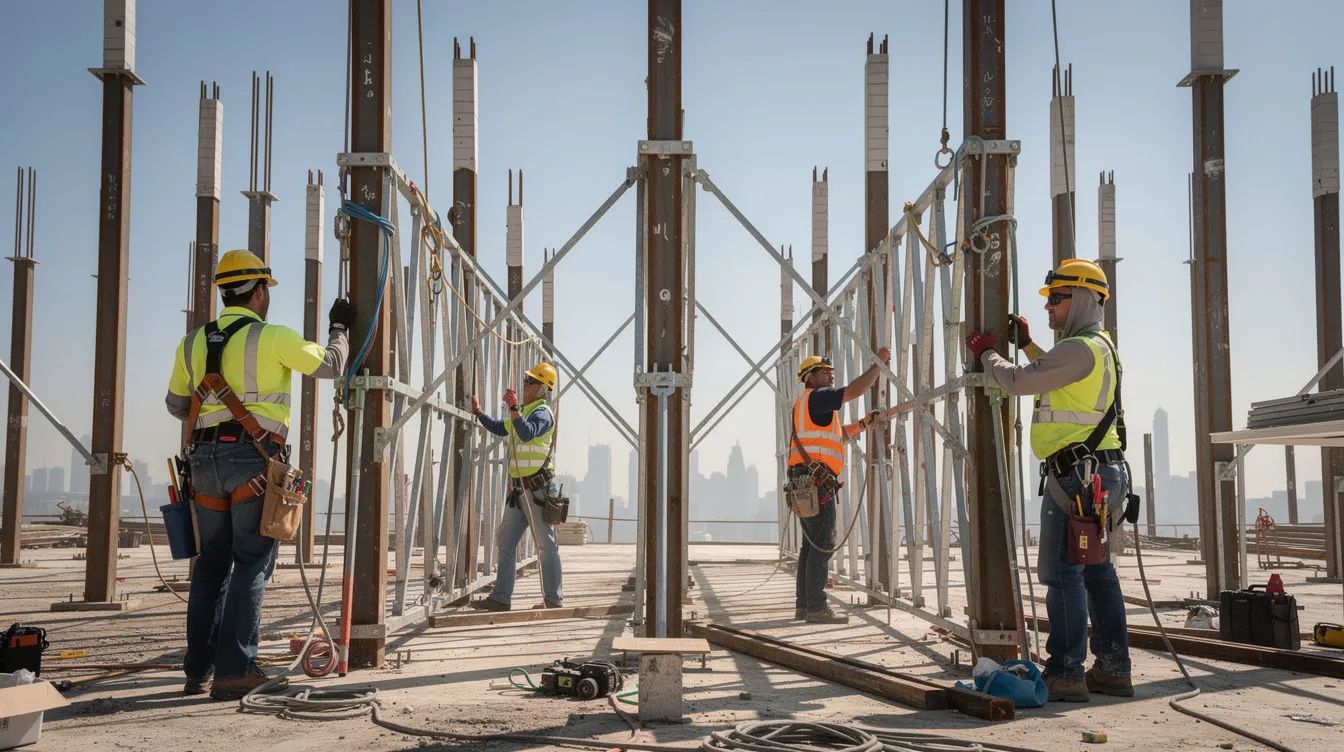
The gap between a smooth steel erection and a schedule disaster almost always traces back to preconstruction steel logistics decisions made weeks before the first truck arrives. ABC South Texas supports members with OSHA 10/30 training, field leadership development, and safety education that reinforces safe steel construction practices across the construction industry and on industrial projects throughout the region.
Members working on I-35 corridor industrial projects, complex hoisting on uneven ground, and multi-trade site congestion can review the chapter’s crane safety and steel logistics planning checklist resources for more detail on crane use, route limits, and structural loads. Use the checklist from this article during preconstruction and again the week before the first truck arrives.
- Schedule a steel readiness review meeting for your next project using the T-30, T-7, and Day-Of checklist above
- Connect with ABC South Texas staff about safety training or apprenticeship programs that build stronger field execution on steel projects in the supply chain
- Visit the ABC South Texas website to explore STEP, OSHA training, and workforce development resources that support the people doing this work every day


